
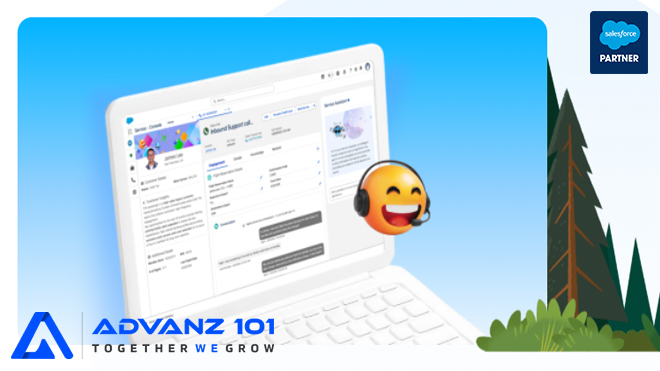
Customer service is entering a new phase of transformation as artificial intelligence becomes embedded directly into enterprise platforms. Organizations are increasingly looking for ways to streamline support operations, improve response times, and deliver personalized customer experiences across channels.
With the launch of Salesforce Agentforce Contact Center, Salesforce is taking a bold step toward redefining how modern contact centers operate. Instead of relying on disconnected systems for telephony, CRM data, and automation, Salesforce has introduced an AI contact center platform that unifies voice, digital channels, CRM intelligence, and AI agents within a single environment.
This shift signals a broader industry trend toward CRM-native contact center architectures, where customer service operations run directly on the CRM platform rather than alongside it.
For enterprises evaluating platform consolidation, AI readiness, and operational efficiency, the introduction of Agentforce Contact Center represents a significant milestone in the evolution of customer experience technology.
Why Traditional Contact Centers Are Reaching Their Limits
Most enterprise contact centers today operate through a complex mix of systems. Organizations often rely on separate solutions for telephony, ticketing, analytics, workforce management, and customer data.
While these tools may integrate with CRM platforms, the architecture typically remains fragmented. This creates several operational challenges:
- Customer information scattered across systems
- Slow response times due to manual data retrieval
- Limited visibility into service interactions
- Difficulty deploying AI-driven automation
As digital engagement continues to grow, these challenges are becoming more pronounced. Customers expect seamless support across phone, chat, messaging apps, and social media channels, without having to repeat information or switch between service agents.
This growing demand has pushed organizations toward unified service platforms capable of supporting AI-driven contact center automation and real-time customer intelligence.
Introducing Salesforce Agentforce Contact Center
The new Agentforce Contact Center is Salesforce’s answer to this challenge. Built directly within the Salesforce ecosystem, the platform combines communication channels, automation, and CRM data into a single operational framework.
Unlike traditional contact center solutions that rely on third-party integrations, Agentforce Contact Center is designed as a CRM-native contact center. This means that voice interactions, digital conversations, and AI-powered workflows are embedded directly into the Salesforce platform.
Key capabilities include:
- Native voice support integrated with CRM records
- AI agents capable of resolving routine customer inquiries
- Omnichannel engagement across voice, chat, and messaging
- Real-time transcription and conversation intelligence
- Unified dashboards for human and AI service agents
By placing the contact center directly within the CRM, Salesforce enables organizations to manage customer interactions with deeper context and greater efficiency.
The Rise of AI Contact Center Platforms
One of the most significant aspects of Agentforce Contact Center is its AI-first design. Instead of positioning AI as a support feature, Salesforce has built the platform around the idea that intelligent automation should be central to customer service operations.
In an AI contact center platform, automation handles repetitive and high-volume tasks while human agents focus on more complex interactions requiring empathy and problem-solving.
Examples of AI-driven service automation include:
- Responding to frequently asked questions
- Processing account updates and requests
- Scheduling appointments or service calls
- Routing interactions to the appropriate department
- Providing real-time knowledge suggestions to agents
When a conversation becomes more complex, the system can seamlessly escalate the interaction to a human representative with full context already available.
Why Native Voice Integration Matters
Voice remains one of the most important communication channels for customer service. However, in many enterprise environments, voice infrastructure exists outside the CRM platform.
This separation often results in fragmented customer records and limited visibility into call interactions.
Agentforce Contact Center addresses this issue by embedding voice directly into the CRM environment. Every call is automatically logged, transcribed, and analyzed using AI capabilities.
This creates a powerful feedback loop where voice interactions become a source of customer intelligence.
Benefits include:
- Real-time insights into customer sentiment
- Complete interaction histories stored in CRM records
- Improved training data for AI automation models
- Faster access to customer context for service agents
Over time, these insights enable organizations to continuously refine their AI-driven contact center automation strategies.
A Unified Workspace for Human and AI Agents
Another important feature of the platform is its ability to manage both human agents and AI agents from a single workspace.
In many organizations today, supervisors must rely on multiple dashboards to monitor service performance. With Agentforce Contact Center, service leaders gain a unified view of operations.
Supervisors can track:
- AI automation performance and resolution rates
- Escalation triggers and service bottlenecks
- Customer sentiment trends
- Agent productivity and interaction outcomes
This level of visibility allows organizations to balance automation and human support effectively.
As a result, enterprises can improve service efficiency while maintaining high levels of customer satisfaction.
The Strategic Impact on the Contact Center Market
Salesforce’s entry into the AI-native contact center space has important implications for the broader customer experience technology market.
Historically, many Salesforce customers have relied on external contact center providers integrated with their CRM environments. With the launch of Agentforce Contact Center, Salesforce is positioning its platform as a unified solution for both CRM and customer engagement.
This does not necessarily eliminate the role of established contact center vendors. Instead, it reflects a growing trend toward platform consolidation where CRM, AI, analytics, and communications operate together within a single ecosystem.
For enterprises, the benefits of this approach include:
- Reduced integration complexity
- Improved data consistency across systems
- Faster deployment of AI capabilities
- Lower long-term operational costs
As AI continues to reshape enterprise software, the convergence of CRM and contact center technology is expected to accelerate.
The Role of Salesforce Service Cloud AI in the Future of Customer Support
The launch of Agentforce Contact Center also strengthens the capabilities of Salesforce Service Cloud AI, which provides advanced automation, analytics, and workflow orchestration for service teams.
By combining Service Cloud intelligence with AI-powered contact center functionality, organizations can create a fully connected customer service ecosystem.
This ecosystem allows service teams to:
- Automate repetitive service processes
- Deliver personalized support experiences
- Predict service issues before they escalate
- Gain real-time insights into customer behavior
Together, these capabilities represent the next generation of Salesforce AI customer service platforms.
How Advanz101 Helps Organizations Adopt Agentforce
As a Salesforce consulting partner with deep expertise in automation and CRM transformation, Advanz101 helps enterprises adopt modern service architectures powered by Salesforce technologies.
Advanz101 works with organizations to:
- Design and implement scalable Salesforce architectures
- Deploy AI-driven automation to streamline workflows and reduce manual effort
- Integrate data, processes, and digital engagement across Salesforce environments
- Enable intelligent decision-making with real-time insights and automation
As Salesforce continues to evolve with AI-native capabilities, enterprises that embrace unified, intelligent platforms will be better positioned to operate faster, improve customer experiences, and scale operations with confidence.
For organizations navigating this shift, the right implementation strategy can turn emerging Salesforce capabilities into measurable business impact. Reach out to start the conversation.