
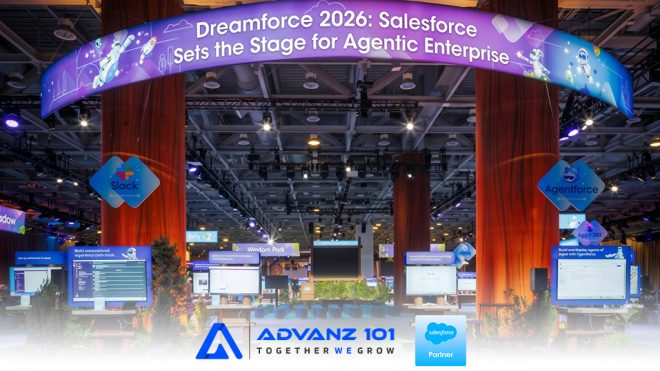
AIforce, Koa, Agentforce and deeper cloud partnerships. Salesforce’s biggest Dreamforce 2026 announcements point to a new phase of enterprise AI. Dreamforce 2026 wrapped up in San Francisco with a message that went well beyond adding AI to CRM.
Across three days, September 15–17, Salesforce laid out its vision for the Agentic Enterprise, where people, AI agents, applications, data and business processes work together to get things done.
For US enterprises, this is particularly relevant. Many organizations have already invested heavily in Salesforce, cloud infrastructure, automation and AI. The next challenge is connecting those investments so that AI agents can perform meaningful work across the business without creating another layer of complexity.
From AIforce and Koa to expanded partnerships with AWS and Google Cloud, here’s a closer look at the major Dreamforce 2026 announcements and what they mean for American businesses.
- AIforce: Salesforce Moves Beyond the Traditional CRM Interface
One of the headline announcements was AIforce, Salesforce’s new live interface layer. AIforce is designed to make Salesforce data, workflows, business logic, permissions and governance accessible within the interfaces where employees and AI agents already work.
In other words, enterprise teams may no longer need to switch constantly between Salesforce and other applications to complete CRM-driven tasks.
For US organizations managing multiple systems across sales, service, finance and operations, this opens up interesting possibilities. Existing investments in Salesforce Flow, Apex, data models and business processes could support a wider range of AI-powered experiences.
The shift is significant. Salesforce is moving towards becoming the trusted execution layer behind enterprise work, not just the application where customer information lives.
- Meet Koa: A Reasoning Model Built Specifically for CRM
Salesforce and NVIDIA introduced Koa, Salesforce’s first reasoning model purpose-built for CRM.
Built on NVIDIA Nemotron, Koa is designed to reason through complex, multi-step enterprise tasks. According to Salesforce, the model was trained using synthetic scenarios reflecting nearly three decades of CRM knowledge, without using customer data for training.
Why does that matter?
A general-purpose AI model can answer questions. A CRM-specific reasoning model is designed to understand the relationships between customer records, business rules, workflows, and the actions required to complete a task.
Think sales qualification, service case routing, record updates and multi-step operational processes.
For American enterprises in financial services, healthcare, manufacturing and other complex industries, specialized reasoning could make AI agents more useful within existing business operations.
Salesforce expects Koa to become generally available in US regions in winter 2026.
- AWS and Google Cloud Partnerships Expand Enterprise AI Choice
Another major Dreamforce theme was Salesforce’s growing commitment to a more open AI ecosystem. Its expanded partnership with Amazon Web Services (AWS) brings Salesforce business context into Amazon Quick, AWS agents into Slack and additional Amazon Bedrock models into Agentforce.
The collaboration also extends Data 360 zero-copy access and connects Agentforce Voice with Amazon Connect Customer through Agent2Agent support.
Meanwhile, Salesforce’s expanded partnership with Google Cloud brings its headless architecture closer to Gemini Enterprise, allowing agents across the two platforms to work with shared business contexts.
Salesforce also announced plans to bring Hyperforce workloads to Google Cloud, with initial migrations for select US customers expected in Q4 2026.
For American CIOs, the implications are practical. Organizations running Salesforce alongside AWS, Google Cloud or other enterprise platforms can explore more connected AI architectures without necessarily rebuilding their entire technology stack around a single model or application.
- Agentforce Moves Further Into Enterprise Operations
If earlier Dreamforce events introduced the promise of autonomous agents, Dreamforce 2026 placed greater emphasis on what those agents can accomplish in production.
Several enterprise announcements illustrated that shift. Live Nation highlighted its Agentforce-powered Venue Agent, designed to answer customer enquiries across 120 venue websites, with the potential to automate more than 300,000 fan enquiries annually.
Adecco Group announced an Agentforce Coworker rollout spanning 40 countries, while Siemens demonstrated how Agentforce can support industrial sales and service operations.
These examples show how agent adoption is moving into functions that directly influence customer experience, employee productivity, and operational efficiency.
The momentum is also reflected in Salesforce’s 2026 Agentic Enterprise Index. The average number of activated agents per organization increased from five to thirteen between February 2025 and April 2026.
For US enterprises, the question is becoming less about how quickly an agent can be built and more about which business processes are ready for agent-driven execution.
- Missionforce Brings AI Further Into Government Operations
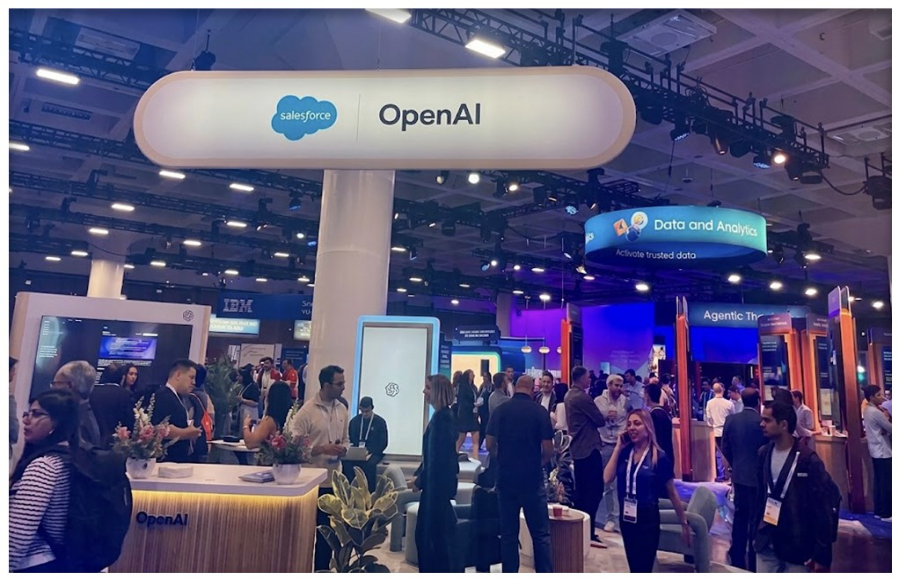
Dreamforce 2026 also saw the expansion of Missionforce, Salesforce’s initiative focused on government and mission-critical environments. Salesforce announced additional work with OpenAI and NVIDIA to support mission intelligence and bring AI into complex public sector operations.
Security, deployment flexibility, trusted data access and governance remain central to this approach.
For US federal, state and local government agencies, as well as regulated commercial organizations, these developments point towards more opportunities to introduce AI into sensitive workflows while maintaining appropriate operational controls.
- What Should US Enterprises Take Away From Dreamforce 2026?
Beyond the individual product announcements, Dreamforce revealed three broader changes in Salesforce’s enterprise strategy.
First, AI is becoming more connected. Through AIforce and expanded cloud partnerships, Salesforce is making it easier for agents to interact with business systems beyond a conventional CRM interface.
Second, AI is becoming more specialized. Koa reflects a move towards reasoning models designed around enterprise processes rather than general-purpose conversations.
Third, execution is becoming a priority. Agentforce is increasingly being positioned around completing work, supporting employees and automating business processes.
For American organizations, this makes the foundations of their Salesforce environment especially important. Clean data, integration readiness, well-defined workflows, security permissions and human oversight will determine how effectively AI agents can operate at scale.
Deploying more agents alone won’t solve fragmented processes or disconnected systems.
- Turning Dreamforce Innovation Into Enterprise Outcomes With Advanz101
Dreamforce 2026 provided a clearer picture of where Salesforce is heading. The next step is translating those innovations into practical business outcomes.
<insert Sumeet’s picwith Bryan Tan>
Sumeet Vyas (L) President and Co-founder of Advanz101, with Bryan Tan, Chief Health Officer at Salesforce
At Advanz101, we help US enterprises make the most of their Salesforce investments through implementation, integration, optimization and industry-focused consulting.
From preparing existing Salesforce environments for Agentforce to connecting enterprise data and designing AI-enabled workflows, our teams help businesses introduce new capabilities with their broader operational goals in mind.
Because becoming an Agentic Enterprise isn’t about deploying AI everywhere. It’s about putting AI to work where it makes a measurable difference.