
AI adoption in the enterprise has moved past the “Should we try it?” stage.
The more interesting question now is: What happens when AI agents become part of everyday work?
The Salesforce Agentic Enterprise Index 2026 offers some useful answers. Based on aggregated usage data from businesses using Agentforce and other Salesforce products, the second edition of the Index looks at how companies are actually deploying agents, what those agents are doing, and whether employees and customers are trusting them enough to use them at scale.
And the numbers point to a fairly clear shift. Enterprises aren’t just experimenting with AI agents anymore. They’re putting them into production, giving them more responsibilities, and measuring the business work they complete.
AI Agents Are Moving From Pilots to Production
One of the most striking findings is the growth in the number of activated agents.
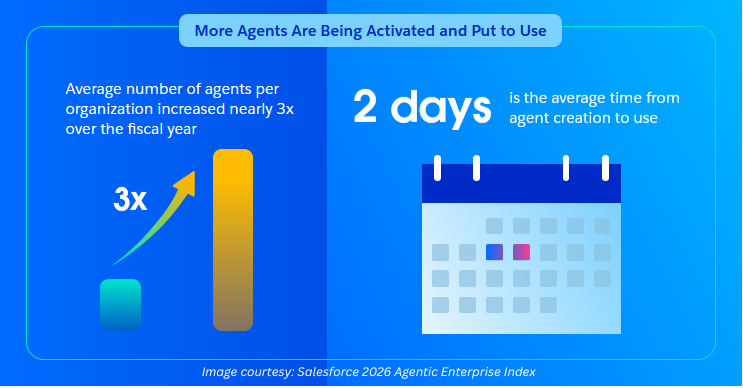
Between February 2025 and April 2026, the average number of activated agents per organization increased from 5 to 13 — nearly a threefold increase. At the same time, the average time required to create an agent fell to around 1.9 days, down 53% from the beginning of the analysis period.
That tells us something important: Businesses are getting better at operationalizing AI. Instead of spending months building a single AI experiment, teams can create an agent, connect it to the right data and workflows, and put it to work much faster.
For enterprise leaders, that changes the economics of experimentation. The conversation starts moving away from “Can we build this?” toward “Where should we deploy it first?”
Agents Are Doing More Than Generating Text
This is probably the most interesting part of the Index. We often think about AI in terms of what it can write: an email, a summary, a response, a report. But enterprise agents are increasingly being measured by what they do.
Salesforce calls this the Action-to-Output ratio, and it has been growing at a 15% compound monthly growth rate. In practical terms, agents are increasingly triggering workflows, updating records, retrieving information, applying business logic and completing tasks rather than simply generating a piece of text.
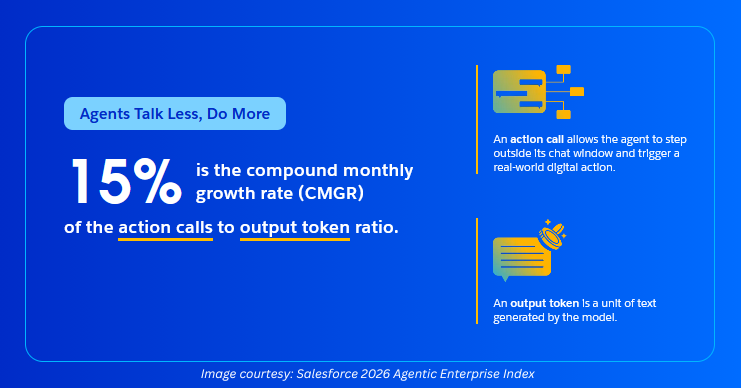
Salesforce also introduced the concept of an Agentic Work Unit (AWU) to measure completed work by an AI agent. By April 2026, Agentforce agents had produced 734 million AWUs, with output increasing at a 15% compound monthly growth rate.
That distinction matters.
An AI assistant that drafts a customer email is useful. An agent that understands the customer request, checks the account, applies the appropriate business rule and triggers the next action is operating at a very different level.
Agents Are Becoming More Capable
The average agent isn’t just doing more work. It is also handling a broader range of tasks.
According to the Index, the average number of unique skills an agent can perform increased from two to six between the beginning of 2025 and the end of the year. During periods of high demand, that capability can expand even further.
Retail is a good example.
During peak shopping periods, retail agents averaged nine skills, representing a 350% increase compared with their normal capability. The reason is simple: customer demand becomes more complicated when volumes spike, so businesses need agents that can move beyond one narrow task.
This is where agentic AI starts looking less like a chatbot and more like a digital member of the workforce.
Different Industries Are Taking Different Paths
There isn’t one universal approach to becoming an agentic enterprise.
Salesforce’s research highlights two broad patterns.
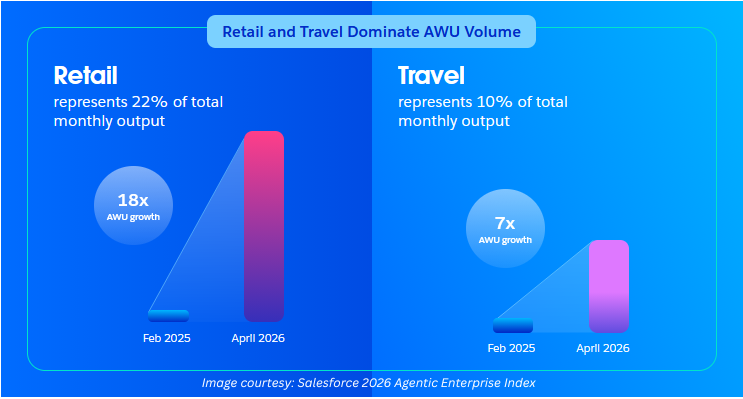
Consumer-facing industries such as retail and travel tend to prioritize speed, scale and volume. Retail alone accounted for 22% of total monthly AWU output in the analysis period and saw an 18x increase in AWU volume from February 2025 to April 2026.
More regulated and operationally complex industries are taking a different route. Financial services, manufacturing, and healthcare and life sciences are deploying fewer agents in some cases, but those agents tend to handle more sophisticated workflows. Salesforce reports that these industries outpaced technology and retail by 66% on agent sophistication.
That’s an important distinction for enterprise decision-makers.
More agents don’t necessarily mean greater task maturity. In a highly regulated business, one agent that can safely execute a complex, multi-step process may create more value than dozens of agents handling simple requests.
Financial Services Shows What Enterprise-Grade Agents Can Look Like
Financial services are particularly interesting because they combine two things that don’t always sit comfortably together: scale and regulation.
The sector represented around 10% of total monthly agent work output and experienced 13x AWU growth from February 2025 to April 2026.
Its Agentforce-powered agents, Ace and Echo, can handle tasks such as checking account balances, reviewing loan application statuses, transferring funds and answering questions from a curated knowledge base. Echo extends similar capabilities into voice interactions.
The bigger takeaway isn’t the technology itself. It’s the governance behind it.
Enterprises operating in regulated environments can’t simply give an AI system unrestricted access and hope for the best. Data access, authentication, permissions, business rules and human escalation all have to be part of the design.
The Business Case Is Becoming Harder to Ignore
There is also evidence that agent adoption can translate into measurable commercial results.
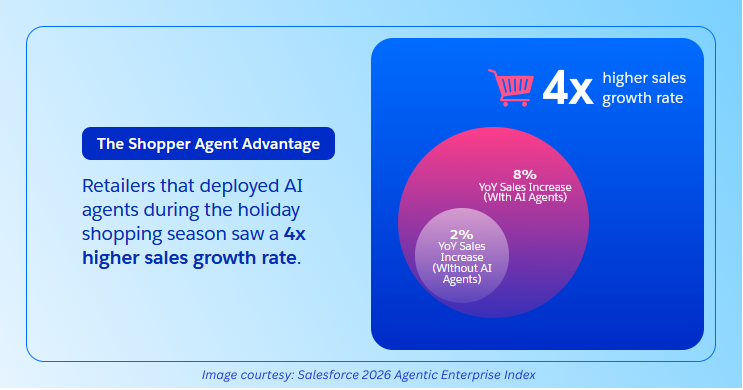
Customer confidence is another piece of the picture. Salesforce reports that 77% of shoppers who interacted with branded onsite shopper agents felt more confident about their purchase, while 74% said they trusted recommendations from AI agents or agentic search.
For businesses, that makes the discussion much more concrete.
The question isn’t simply whether AI is impressive. It’s whether AI can improve customer experiences, reduce operational friction, and help employees spend more time on work that actually requires human judgment.
What This Means for Enterprise Leaders
The Salesforce Agentic Enterprise Index 2026 doesn’t suggest that every company needs hundreds of AI agents tomorrow. If anything, it suggests the opposite.
The most effective strategy will depend on your business model, customer expectations, regulatory environment and operational complexity. A retailer may start with high-volume customer service. A financial institution may prioritize tightly governed, multi-step workflows. A manufacturer may focus on sales qualification, service operations or supply-chain processes. The common thread is execution.
For enterprise leaders, the opportunity now isn’t to deploy AI everywhere. It’s to identify where an agent can take meaningful work off your team’s plate — safely, measurably and at a scale your business can support.
At Advanz101, we help enterprises turn this shift into reality by designing and implementing Agentforce solutions tailored to your business processes, ensuring your AI agents are not just deployed, but actually delivering measurable outcomes.
Info courtesy: salesforce.com